
Cloud Migration as an Organizational Priority
Cloud computing offers many benefits for public and private sector organizations, including improved performance, scalability, and flexibility compared to managing systems in conventional data centers and the potential for cost savings. The anticipated advantages from moving systems and data to the cloud influences strategic planning and information technology management policies that prioritize migration to the cloud. While cloud computing may not be ideal for every system, many organizations face significant pressure to move their IT operations to the cloud wherever feasible. Where commercial companies might look to the cloud as a source of competitive advantage, the rationale for government agencies is more likely to be driven by desires to optimize cost, enhance service delivery, or achieve more efficient allocation of resources. The availability of cloud-native services also presents an opportunity for organizations to adopt emerging technologies and implement capabilities that are impractical or infeasible to implement in on-premises environments.
Many cloud migration methodologies are available to organizations, each differing in terms of expected level of effort, expected benefits, business and technical requirements, and time required to complete a migration project. Many organizations choose to simply re-host or relocate their systems from on-premises data centers to the cloud, using a migration strategy known as “lift and shift.” The defining characteristic of this approach is that an organization maintains the same (or substantially the same) technology stack or solution architecture for an existing system but shifts the operating environment to the cloud. Government agencies are sometimes criticized for using “lift and shift” cloud migration, under the assumption that this approach limits the benefits that could be realized from re-engineering systems to take advantage of cloud-native services and capabilities. Such arguments fail to acknowledge that re-architecting existing systems to optimize operations in the cloud takes significant time and effort and may require cloud knowledge or skillsets that government program teams do not have. For many government agencies (and commercial companies, for that matter), keeping the same technology and system design provides a lower-risk, less complicated, and faster migration path. This type of cloud migration is not without challenges, however, and business and system owners considering cloud migration or facing pressure to move to the cloud often struggle to create and follow migration plans that will succeed.
Lift-and-Shift Migration Planning
To increase the chance of successful cloud migration and minimize the time needed to complete system migration, organizations need to develop and execute migration plans that follow three parallel paths: database migration, application migration, and network migration. Each of these aspects is driven by existing functional and technical requirements that need to be met in a cloud computing environment. Successful cloud migration planning brings together people with system-specific knowledge and expertise and people with experience with deploying solutions in the cloud computing environment the organization chooses to use.
One way to reduce the overall time required for system migration is to coordinate the management of the current as-is system environment and the to-be cloud environment so that work on network, application, and database configuration, testing, and operations is performed at the same time. This approach is intended to synchronize data, application software, and network connectivity early in the migration process and provide frequent checkpoints to ensure that migration remains on track and to validate that all internal and external dependencies are resolved before the final cutover.
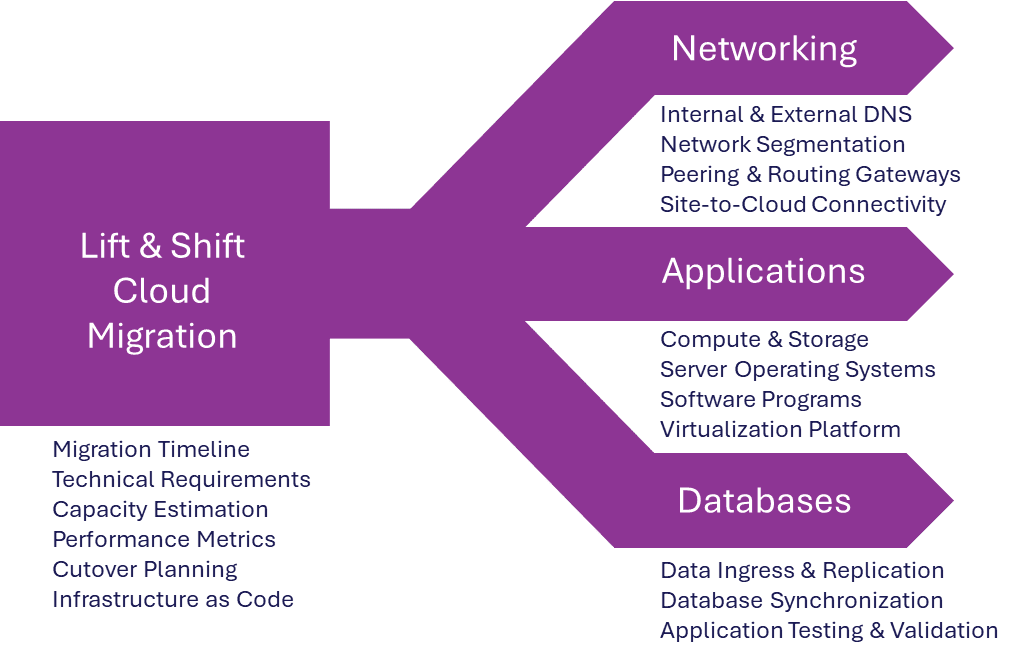
Through the system migration process, organizations should maintain the target cloud environment and establish connectivity between the on-premises source and cloud destination environment. There may be opportunities to leverage scripting or infrastructure-as-code technologies like Terraform to provision the needed cloud-based services and infrastructure and enable the system team to install software, populate databases, and verify networking services.Working on both source and target environments simultaneously reduces migration time and enables iterative testing cycles to validate different elements of the system architecture.
From Planning to Implementation
The most obvious benefits to organizations using this cloud migration approach are a drastic reduction in the time required to migrate systems and a substantial increase in the success rate for system migration projects. A well-designed plan facilitates, but does not guarantee, success. Network, application, and database migration each present their own challenges and opportunities, and each warrant focused attention within a lift-and-shift cloud migration project. These three areas will be addressed with their own articles in the next few weeks.