Accelerating Cloud Migration with Early Data Replication
At iVision Consulting, we know that data migration is one of the most critical and often underestimated elements when moving applications to the cloud. How you handle data transfer directly impacts how quickly and smoothly applications can go live, and it can mean the difference between a seamless transition and extended downtime.
Too often, organizations wait until the very end of their migration process to replicate or transfer data from production databases to new cloud environments. For applications with large volumes of data, this late-stage approach can cause significant delays in testing, readiness, and final cutover. By initiating database migration at the beginning of the process, organizations can:
- Minimize application downtime during cloud cutover
- Accelerate implementation and testing phases
- Reduce overall migration risk
This proactive approach has proven especially effective in our application-first migration strategies executed for various clients, ensuring that data readiness aligns with application go-live timelines.
Database Replication as a Lift-and-Shift Accelerator
When a cloud migration involves applications supported by databases, whether commercial platforms like Oracle Database or Microsoft SQL Server or custom-developed solutions, addressing database replication as a dedicated migration task is essential. Most two-, three-, and four-tier application architectures used in commercial off-the-shelf (COTS) software and in custom-developed applications rely on a distinct database tier, making replication a critical step in preserving application functionality post-migration.
Major database vendors embed replication capabilities into their platforms, and most cloud service providers (CSPs) offer managed services to facilitate this process. These same replication tools, often used for disaster recovery or business continuity, can also enable seamless transition from on-premises to cloud environments.
However, not all database replication services are created equal. While all major cloud vendors have comparable services and capabilities when it comes to compute, storage, and networking services, there are meaningful differences among CSPs and database vendors in the tools and services they provide to facilitate data replication and synchronization between database instances and environments. Oracle and Microsoft both, for example, incorporate data replications services, but they are implemented differently, particularly with respect to services available in cloud computing environments. For instance, organizations using Oracle Database software for their cloud-based applications use Data Guard and GoldenGate to replicate data in Oracle Database instances to corresponding services running in Oracle Cloud Infrastructure (OCI).
Optimizing the Replication Process
At iVision Consulting, we treat database replication as a structured, repeatable process that minimizes downtime and accelerates cloud readiness. Our approach includes:
1. Establish secure connectivity. We begin by creating a secure and reliable network connection between the current operating environment and the target cloud environment. This ensures data can move freely and securely during the replication process. We perform an initial data load, which can take hours or days depending on the size of the database.
2. Provision the cloud database. Next, we create the cloud-based database, either on a dedicated virtual machine, as a customer-managed instance, or using a CSP-managed database service.
3. Perform the initial data load. We copy the entire source database to the cloud. Depending on database size, this may take hours or several days. This creates a complete baseline in the cloud environment.
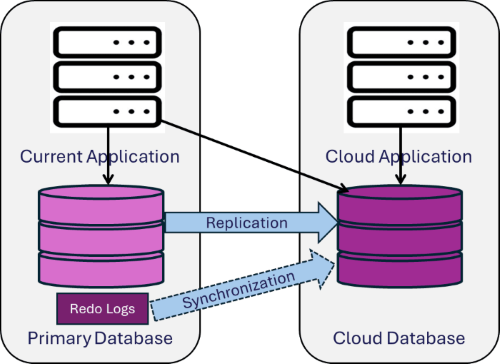
4. Enable continuous synchronization. Once the initial load is complete, replication tools, such as Oracle Data Guard and GoldenGate, or Microsoft SQL Server replication with Publisher, Subscriber, and optional Distributor roles, capture ongoing changes in near real time and apply them to the cloud database. This keeps the two environments in sync throughout the migration, as shown in the figure below.
5. Conduct testing checkpoints. Replication can be paused at designated points in the migration plan to allow application teams to test functionality, performance, and integrations against live, current data in the cloud.
6. Leverage CSP-managed services where possible. In OCI, Data Guard and GoldenGate are offered as managed services, simplifying configuration and reducing operational overhead. For hybrid or multi-cloud migrations, these same capabilities are available through Oracle Database@Azure and Oracle Database@AWS.
7. Cut over with minimal disruption. By keeping the cloud database synchronized until the final cutover, application downtime is minimized and end users experience a smooth transition to the new environment.
Completing replication early in the migration cycle allows application teams to test against live, current data in the cloud, validate integrations, and prepare for cutover with minimal user disruption. This not only accelerates the migration process for our customers but also builds confidence that their cloud environment is ready for production from day one.
Building Confidence in Cloud Readiness
Treating database replication as a core part of our application migration strategy ensures that data, applications, and users all transition to the cloud with speed, accuracy, and minimal downtime. For our federal customers, this means faster go-lives, reduced operational risk, and predictable cost outcomes, while maintaining compliance with federal governance and security requirements.
At iVision Consulting, we combine proven replication tools with an application-first methodology to deliver migrations that are fast, predictable, and resilient. Our approach empowers our customers to test with live, current data early in the process, validate integrations with confidence, and execute cutovers with minimal disruption so that mission-critical systems are cloud-ready from day one. The result is a secure, compliant, and cost-effective migration that supports both immediate needs and long-term modernization goals.