
Network Configuration Before and During Migration
At iVision Consulting, we know that successful cloud migration isn’t just about moving applications and data. It also depends on how well the network is planned and configured. Setting up connectivity for applications in the cloud is a key factor for success both during and after migration. The scope of networking services needed can vary depending on whether the organization’s current infrastructure will connect to the cloud only for the migration or remain linked long term; what URL will be used for the application; and whether the application will be accessed from public networks like the Internet. Putting reliable connections in place ahead of time makes it easier to move and synchronize data, keep users and administrators connected, and support hybrid environments where on-premises and cloud systems need to stay linked. Bridging these environments also requires careful planning to avoid overlapping IP addresses and to ensure the right routing and DNS services are in place.
Cloud Networking Services Used in Lift-and-Shift Migration
Virtual network services need to be defined and configured in the cloud before application components or supporting compute and storage resources can be deployed. Organizations can configure their own IP addresses and subnets using private CIDR ranges, but they need to be careful not to overlap with existing LAN or VLAN addresses on-premises. Network planning should also cover whether new URLs or subdomains will be created in the cloud, or if existing ones will be reused for applications already in production.
These migration planning aspects require coordination between application teams and IT administrators because the way networking is configured for one application can impact others across the environment.
While the overall solution architecture doesn’t change much in a lift-and-shift model, cloud-hosted applications typically involve more network components than traditional on-premises deployments. As shown in the figure below, modern apps generally use a web server at the presentation tier and, if externally accessible, route traffic through a firewall. In the cloud, traffic flows through additional layers: an Internet gateway, one or more virtual firewalls (via security groups or ACLs), and a load balancer. Many organizations also choose to add a web application firewall (WAF) for extra protection, either as a service from the cloud provider or as a standalone solution. Decisions like using a WAF or network load balancer also affect DNS, since many cloud services don’t have fixed external IPs. Because DNS changes are often the final step in migration, planning them in advance helps reduce downtime and ensures users can get to the application quickly.
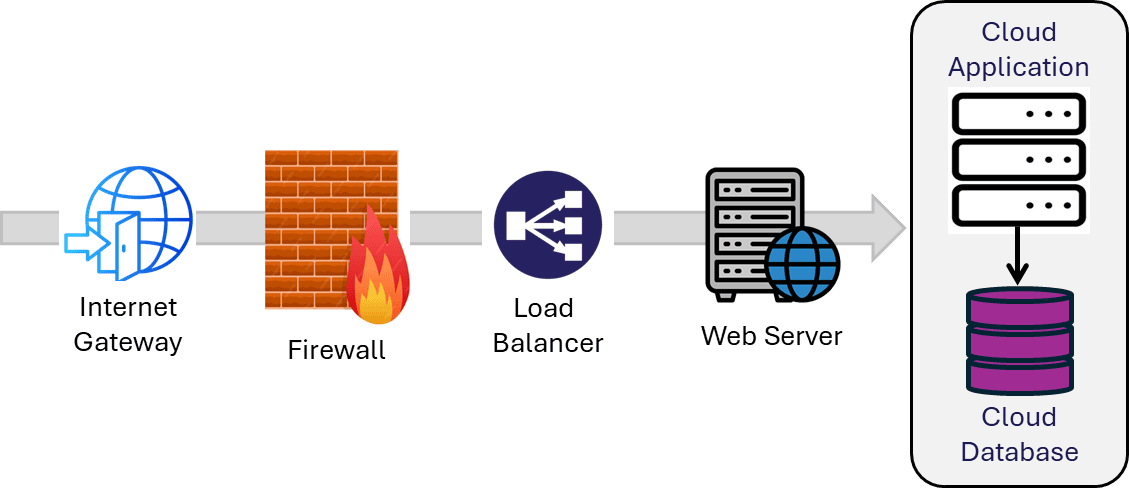
Another important consideration is how to connect internal networks to cloud environments. For short-term migration needs, organizations often use virtual private networks (VPNs), which are quick to set up and secure. For longer-term or permanent connectivity, dedicated interconnect services such as Oracle FastConnect, AWS Direct Connect, or Azure ExpressRoute offer higher performance, lower latency, and more reliability.
Choosing the right option early ensures that the migration not only runs smoothly but also supports the organization’s long-term cloud strategy.
Preparing for Network Cutover
Most aspects of cloud migration can be made nearly invisible to end users, if network cutover is carefully managed. For well-established applications with large user bases, keeping consistent domains and URLs is often a top priority to minimize disruption. However, a single URL can’t be used for both the pre-migration and post-migration environments at the same time, so temporary addresses and updated DNS settings are part of the application migration process.
For internal users, updated routing and DNS changes can restore access quickly after cutover. For external users, accessibility can take longer as DNS updates propagate across global name servers, sometimes over several hours. Using external DNS services from providers such as Akamai, Cloudflare, or cloud vendors like AWS, Google, or Microsoft can shorten this propagation window and reduce downtime.
Powering Your Migration with iVision Consulting’s Proven Expertise
When it comes to cloud migration, the network is more than just a technical detail. It is the backbone that makes everything else work. Careful planning around connectivity, DNS, routing, and security ensures that applications stay available, data stays synchronized, and users experience little to no disruption.
At iVision Consulting, our focus is on helping organizations migrate with confidence by avoiding common pitfalls and ensuring networks are ready to perform from day one. As a trusted Oracle partner, we bring deep knowledge of Oracle Cloud Infrastructure (OCI) along with experience across other leading cloud platforms. Combined with our ISO 9001:2015 certification and CMMI-DEV Level 3 appraisal, we apply disciplined, proven processes that keep migrations on track while delivering the flexibility and scalability clients need.
By partnering with iVision Consulting, organizations can minimize downtime, accelerate time to value, and create a strong foundation for cloud success that lasts well beyond the initial migration. This commitment to performance, reliability, and long-term results is what defines iVision Consulting’s approach to powering your vision in the cloud.